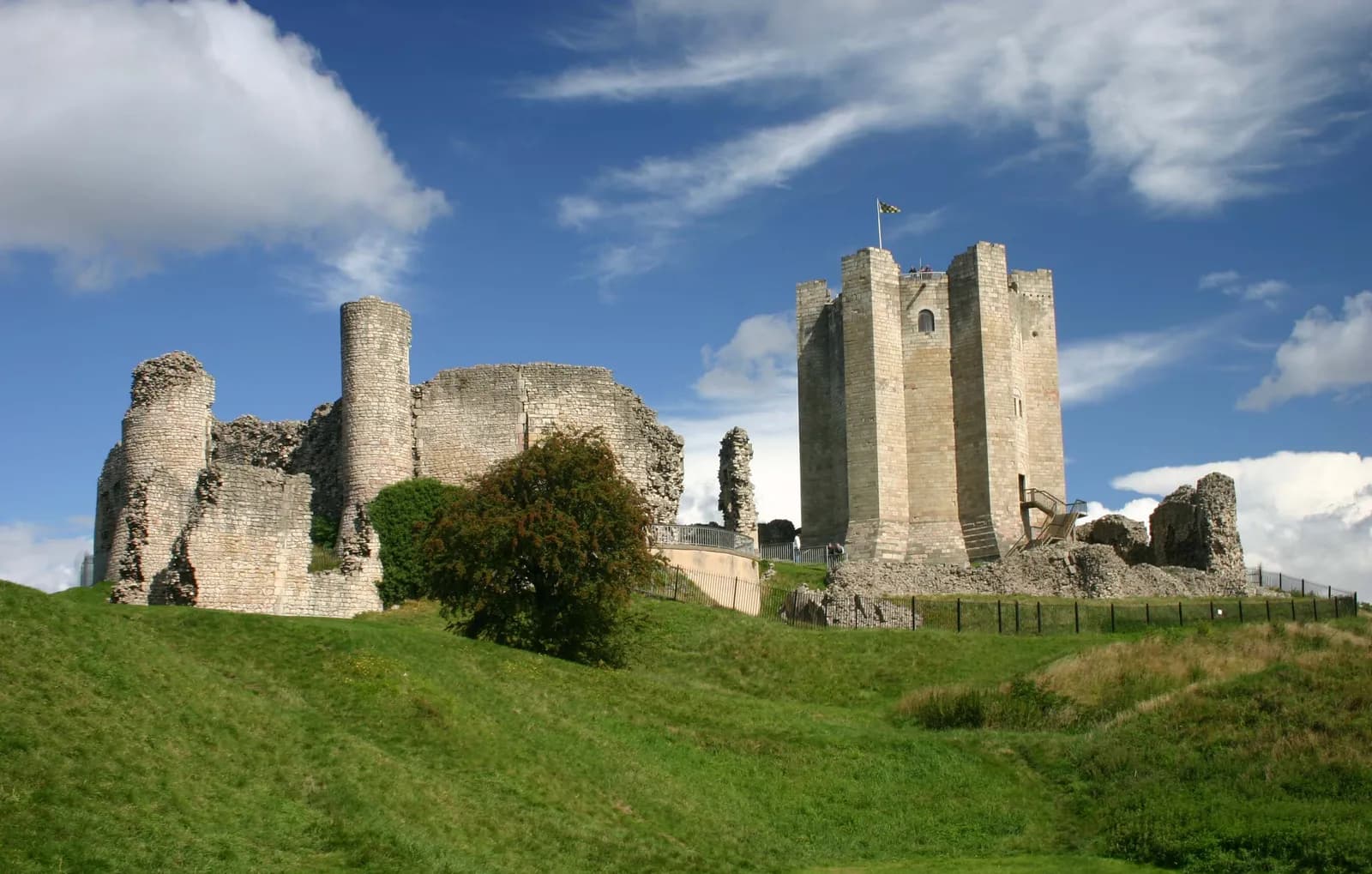
Rising 28 metres above the Dearne Valley, Conisbrough Castle's striking hexagonal keep has dominated the Doncaster skyline for more than 800 years. This architectural oddity, unique among English medieval fortifications, inspired Sir Walter Scott's celebrated novel Ivanhoe and remains one of South Yorkshire's most significant heritage landmarks.
The Norman Foundation
The castle's origins trace to the aftermath of the Norman Conquest. William de Warenne, 1st Earl of Surrey, received the manor of Conisbrough; formerly the property of King Harold II; and established the first fortifications during the late 11th century.
The castle owes its distinctive character to Hamelin Plantagenet, the illegitimate son of Geoffrey of Anjou and half-brother to Henry II. Following his marriage to Isabel de Warenne in April 1164, Hamelin commissioned the stone keep between approximately 1180 and 1190. The structure represents one of the finest examples of late Norman defensive architecture, though historians note its design prioritised status over military function.
The Hexagonal Marvel
The keep's six-sided design is unprecedented in English castle architecture. A central circular tower, 62 feet in diameter, is encircled by six massive solid buttresses projecting outwards. The walls reach thicknesses of up to 15 feet in places. Four floors accommodate a basement with a well, an entry-level first floor, two upper chambers for the lord's use, and a roof walk offering commanding views across the valley.
Perhaps the most remarkable feature is a vaulted hexagonal chapel carved directly into one of the buttresses; a testament to the spiritual as well as martial concerns of the castle's builders. Despite its impressive appearance, military historians have identified tactical vulnerabilities: the twelve corners created by the hexagonal design provided potential weak points, and the absence of arrow slits severely limited defensive capabilities.
The keep underwent substantial conservation work between 1993 and 1995, when European Union funding enabled re-roofing and re-flooring. A further £1.1 million renovation programme, funded by the Heritage Lottery Fund in 2013, delivered a new visitor centre and improved facilities.
Royal Connections and the House of York
Conisbrough Castle played a pivotal role in the bloodline that would shape English history. After the death of John de Warenne, 7th Earl of Surrey in 1347, the castle reverted to the Crown and was granted to Edmund of Langley, 1st Duke of York, fourth surviving son of Edward III. Edmund founded the House of York, and his second son Richard of Conisburgh was born within the castle walls on 20 July 1385.
Richard of Conisburgh, 3rd Earl of Cambridge, met his end at the executioner's block in 1415 for his involvement in the Southampton Plot against Henry V. Yet his descendants achieved the throne: his grandson Edward IV seized the crown in 1461, returning Conisbrough to royal ownership.
The Ivanhoe Legacy
The castle's literary fame began in 1811 when Sir Walter Scott passed through Conisbrough. The novelist incorporated the castle into Ivanhoe (1819) as "Coningsburgh Castle", the fictional seat of Athelstane and the site of a Saxon court scene. Scott's description reflected the Romantic-era fascination with medieval ruins, though he mistakenly believed the structure to be of Saxon rather than Norman origin; a misconception common among 19th-century antiquarians.
Scott's novel transformed Conisbrough from a local curiosity into a destination for literary tourists. The connection remains central to the castle's identity today, with English Heritage's visitor centre featuring exhibitions that trace this literary heritage.
Decline and Preservation
The castle's survival owes much to geological misfortune. By 1537, a royal survey recorded collapsed gates, a ruined bridge, and structural failures caused by land slippage on the Magnesian Limestone bedrock. One floor of the keep had already fallen in. This premature decay ironically protected Conisbrough during the English Civil War; the castle was already indefensible and escaped the deliberate slighting that destroyed so many fortifications.
Following Elizabeth I's grant of the ruin to Henry Carey, Lord Hunsdon in 1559, the castle passed through various aristocratic hands. Thomas Osborne, 4th Duke of Leeds, purchased it for £22,500 in 1737. The modern era of conservation began in 1949, when Conisbrough local council placed the castle under Ministry of Public Works guardianship.
Conisbrough Today
Now jointly managed by Doncaster Metropolitan Borough Council and English Heritage, Conisbrough Castle attracts approximately 30,000 visitors annually. The Grade I listed building and Scheduled Ancient Monument offers a compelling combination of architectural splendour and historical significance.
The visitor experience includes a cutaway model of the keep, graphic novel-style interpretation, and wall-projected figures that guide visitors through the three main chambers and the miniature chapel. Visitors can explore the four floors of the keep and enjoy panoramic views from the roof walk across the Dearne Valley.
The castle stands as a powerful reminder of Doncaster's deep historical roots. The very name Conisbrough derives from the Old English "Cyningesburh", meaning "king's stronghold", reflecting the area's importance since Anglo-Saxon times. As Conisbrough bids for recognition as the UK's first Town of Culture in 2028, the castle remains the town's defining landmark and a source of civic pride within the borough of Doncaster.
Practical Information
Conisbrough Castle is open daily from 10am to 5pm, with last entry at 4:30pm. The castle is located at Castle Hill, Conisbrough, Doncaster, DN12 3BU. Admission details and advance booking options are available through English Heritage.