The Birthplace of Modern Rail
Doncaster occupies a unique position in British industrial history as the town where locomotive manufacturing helped to shape the modern railway age. The Doncaster Railway Works, established in 1853 by the Great Northern Railway, became one of the most significant railway engineering sites in the United Kingdom. The plant was commonly known locally as "the Plant" and, at its peak, employed thousands of Doncaster residents.
The works produced some of Britain's most famous steam locomotives. The Flying Scotsman, perhaps the world's best-known steam engine, was built at Doncaster in 1923. This locomotive became the first to achieve an authenticated speed of 100 miles per hour and later completed the first non-stop run between London King's Cross and Edinburgh Waverley. The Mallard, which still holds the world speed record for steam locomotives at 126 miles per hour, was also constructed at Doncaster in 1938.
Although the works closed in 2007 after more than 150 years of operation, their legacy remains embedded in Doncaster's identity. The town's railway station continues to serve as a major interchange on the East Coast Main Line, with regular services connecting Doncaster to London, Edinburgh, Leeds, and Sheffield.
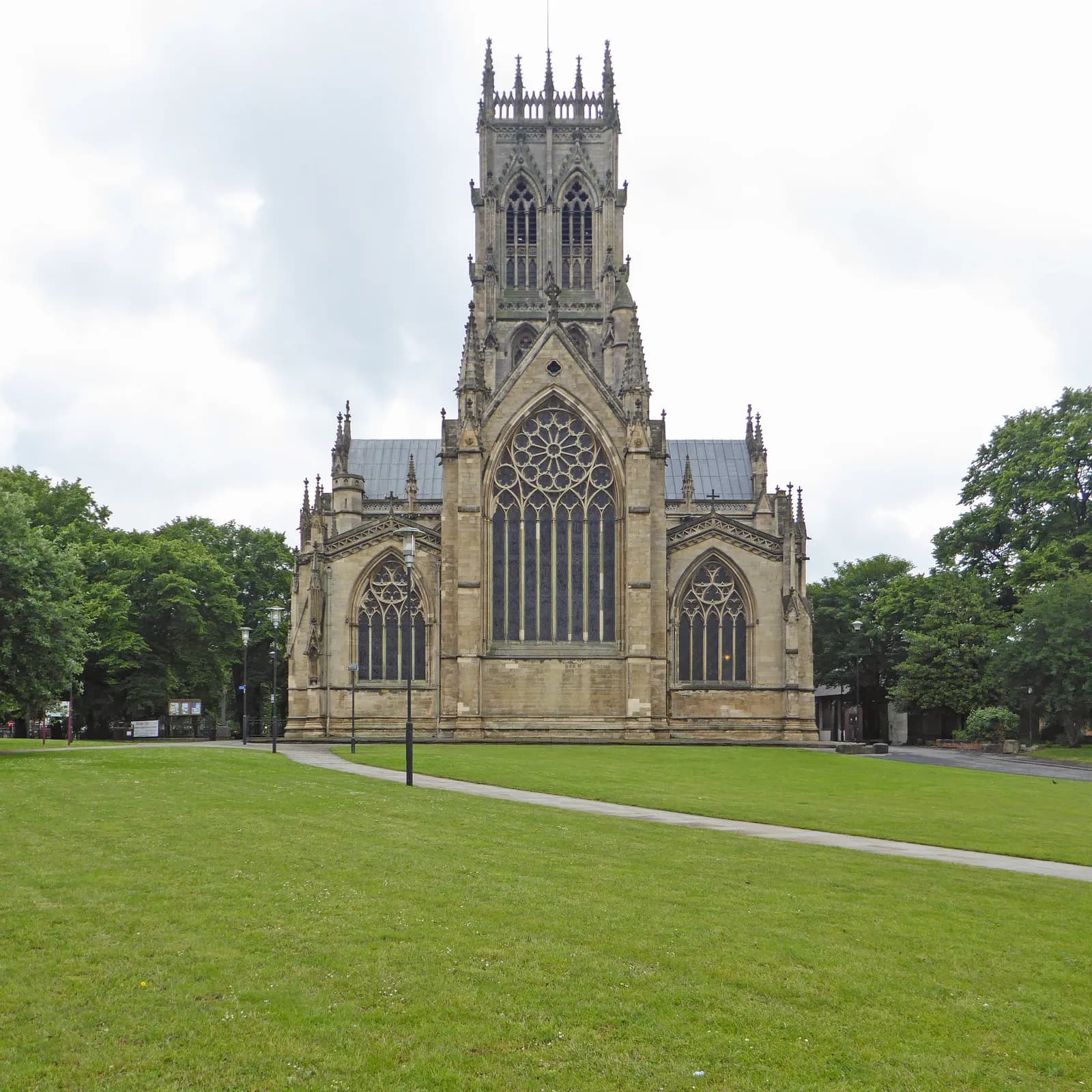
The Minster Church of St George
Standing at the heart of Doncaster is the Minster Church of St George, a building whose history predates the railway age by many centuries. The site has held a church for over 800 years, though the current structure was rebuilt after a fire in 1853 destroyed much of the medieval building.
The Minster was elevated to its current status in 2004 when it was designated as one of the Church of England's new minsters, recognising its importance as a centre of worship and community life in South Yorkshire. The church contains architectural features spanning several centuries, including Victorian stained glass and a medieval font that survived the 1853 fire.
The churchyard and surrounding area form part of Doncaster's historic town centre, which has undergone significant regeneration in recent decades. The Minster remains an active place of worship and hosts regular services, concerts, and community events.
A Town of Contrasts
Doncaster's identity reflects the interplay between these two heritage strands: the industrial engineering tradition represented by the railway works, and the ecclesiastical history embodied by the Minster. The town has evolved from a market settlement into a substantial urban centre serving as the principal town of the Metropolitan Borough of Doncaster.
The borough encompasses not only the urban core but also surrounding towns and villages including Tickhill, Thorne, and Conisbrough, each with its own distinct character. Tickhill retains much of its medieval street pattern and castle remains, while Thorne developed historically as a centre for peat extraction and waterborne trade.
Today, Doncaster continues to develop its transport connections beyond rail. The town sits at the intersection of major road routes including the M18 and A1(M) motorways, and Robin Hood Airport Doncaster Sheffield provides air links from the edge of the borough.